Pneumatic piercing can be highly repeatable on the right short crossing, but “reliable” is not a property of the tool alone. It is the result of a straight and measurable acceptance corridor, a stable launch, reasonably uniform displaceable ground, adequate cover, verified utility clearance, a maintained air system, and a recovery plan. Remove any one of those conditions and a method that looked simple on paper can become difficult to control.
For routes that pass that screen, GRUNDOMAT pneumatic piercing tools provide a range of tool sizes and configurations for short trenchless work. Model selection should come after the allowable line-and-grade error, product outside diameter, soil response, pit geometry, air demand, and fallback method have been defined. The practical question is not “Does piercing work?” It is “Can this specific setup keep this specific installation inside its required corridor?”
Reliability Is a Tolerance Question, Not a Reputation
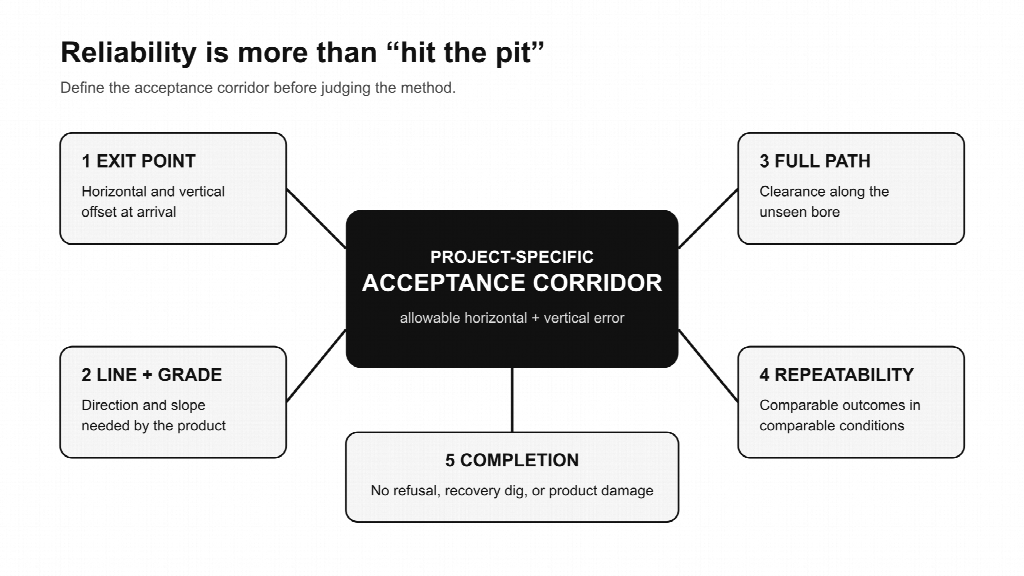
A useful reliability review begins by separating five outcomes that are often blended together:
- Exit-point error: the horizontal and vertical difference between the planned and actual arrival point.
- Line and grade: whether the tool follows the intended direction and slope closely enough for the product and connections.
- Full-path clearance: whether the unseen bore remains outside required offsets from existing utilities, structures, pavement, and grade.
- Repeatability: whether comparable launches in comparable ground produce comparable results.
- Completion: whether the tool finishes the run without refusal, reversal, excavation, or product damage.
These measures answer different questions. A tool may arrive inside a broad receiving pit while missing a tight service connection. It may hit the target but pass closer to an existing utility than the exit point suggests. It may also maintain acceptable line and grade yet stop short because of a cobble or buried debris. Calling all three outcomes “accurate” hides the failure mode that matters.
The Trenchless Technology Center's Guidelines for Impact Moling says that, in stable ground and with proper initial alignment, a non-steerable mole can be expected to remain within 1% of bore length in line and grade. That statement is useful for preliminary planning, but it is not a universal average, a 99% success probability, or a warranty. The conditions attached to it—stable ground and proper alignment—are doing most of the work.
Translated into distance, a 1% reference gives the following offsets. Horizontal and vertical error should be considered separately.
Bore length
1% reference offset
20 ft
2.4 in
30 ft
3.6 in
40 ft
4.8 in
50 ft
6.0 in
Those values may be acceptable for a generous receiving pit and unsuitable for a narrow sleeve, a gravity service, or a congested corridor. The evidence review of pneumatic piercing accuracy makes the important distinction between a planning benchmark and a measured probability. A project should therefore define its own allowable corridor before deciding that the method is reliable enough.
A receiving pit can make performance look better than it is
If a receiving pit is 36 inches wide and the tool exits 10 inches from the planned centerline, the run may be recovered easily. Operationally, that may be a success. Geometrically, it is still a 10-inch offset. Recording only “arrived in pit” makes later projects appear more predictable than the underlying data supports.
The same issue applies to depth. Measuring entry and exit elevations does not prove the tool held a straight vertical profile between them. Where intermediate clearance is critical, the design must rely on verified separation, exposure, tracking where appropriate, or a different installation method—not on the receiving pit as evidence of the hidden path.
Launch Error Sets the First Accuracy Limit
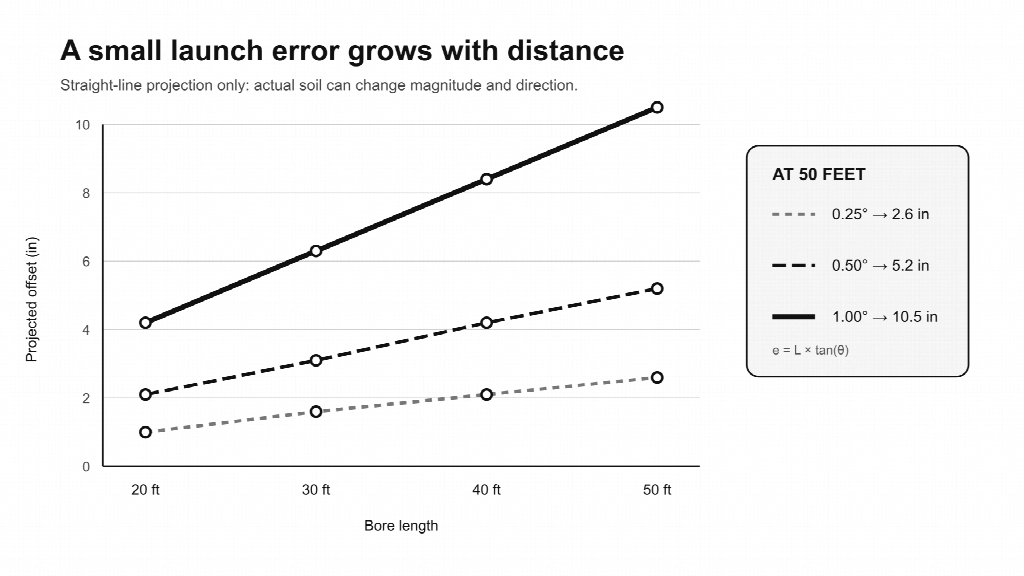
An unsteered pneumatic tool carries the launch direction into the ground. Before soil variability is considered, a simple straight-line projection shows how quickly a small angular error grows:
Projected offset = bore length × tan(angular error)
Launch-angle error
20 ft
30 ft
40 ft
50 ft
0.25°
1.0 in
1.6 in
2.1 in
2.6 in
0.50°
2.1 in
3.1 in
4.2 in
5.2 in
1.00°
4.2 in
6.3 in
8.4 in
10.5 in
At 50 feet, a one-degree error projects to roughly 10.5 inches even if the tool follows a perfectly straight line. Real soil can increase that error, reduce it, or turn it in another direction. The calculation is not a prediction of the final path; it isolates the part of the result that the launch crew can control.
Alignment is a setup process, not a single reading
The launch and receiving pits need stable floors, sufficient length for the tool and alignment system, and an unobstructed reference line. A level placed on an unsupported tool is not enough if the cradle can settle, the pit wall can move, or the launch face crumbles as the nose enters.
Manufacturer operating guidance for conventional GRUNDOMAT tools instructs crews to start at reduced power and continue checking line and grade until the tool is fully in the ground. It also warns that the path cannot be corrected after full entry. That makes the first tool lengths a control window: movement can still be detected and the launch can be stopped before the alignment error becomes buried and expensive.
A defensible launch procedure records the planned bearing and grade, verifies the aiming frame against independent references, checks the tool during staged entry, and defines a stop limit. “Looks close” is not a measurable acceptance criterion.
Ground Conditions Decide Whether the Line Holds
Pneumatic piercing advances by compacting and displacing soil around the tool. It is therefore most predictable when the ground supplies reasonably uniform resistance and side support. The same mechanism becomes less predictable when the tool crosses materials with sharply different stiffness, density, particle size, or moisture.
Ground condition
Expected response
Reliability implication
Uniform clay or silt
Consistent confinement and resistance
Usually the best candidate after site verification
Very soft or saturated soil
Weak reaction; possible sinking, swimming, or oscillation
Increase uncertainty; assess dewatering and alternative methods
Loose sand or gravel
Inconsistent support and possible collapse
Greater deviation and settlement risk
Dense, dry, or cemented layer
High resistance
Refusal, slowdown, or deflection becomes more likely
Mixed fill or old trench
Tool may follow the softer zone
Direction can change at material boundaries
Cobbles, roots, debris, concrete
Local obstruction
Deflection, refusal, tool damage, or recovery excavation
Solid unfracturable rock
No practical displacement path
Conventional pneumatic piercing is generally unsuitable
Uniformity matters as much as the soil name
“Clay” is not a complete ground model. A route may begin in stiff native clay, cross a loosely backfilled service trench, encounter saturated material below a leaking main, and finish in compacted aggregate. Each transition changes the forces on the nose and body. A short bore through variable fill can be less predictable than a longer bore through uniform native soil.
Site history is therefore useful evidence. Previous trenching, demolished foundations, repaired pavement, tree lines, abandoned utilities, and drainage problems identify places where the subsurface may not match a general soil map. Test pits and safe exposures at critical locations reduce uncertainty more directly than a broad geotechnical description.
Case histories show possibility, not probability
A reported Iowa installation used a 2.5-inch tool for a 48-foot bore in black fat clay with groundwater close to the excavation depth. The pits were dewatered and the tool was supported with a cradle and aiming frame. At one monitored location, the measured depth differed from the expected depth by about six inches. The case is useful because it documents conditions and controls; it does not establish a typical six-inch error or a general success rate.
That is the right way to use project evidence: compare ground, tool, distance, support, and acceptance conditions. A successful bore in dissimilar soil is not proof that another route will behave the same way.
Equipment and Operating Condition Change the Outcome
Tool geometry, condition, and air delivery influence whether the tool can cycle consistently and resist small disturbances. TT describes the reciprocating stepped-cone head and long body of GRUNDOMAT tools as features intended to support directional stability. That is a manufacturer design claim, not independent quantified proof that every bore will meet a particular tolerance. Its value still depends on correct model selection and operating condition.
Select the exact system, not a nominal diameter
The product outside diameter and joint geometry determine the required bore and pulling arrangement. The soil determines how much displacement is reasonable. Cover limits, pit size, tool weight, launch support, and compressor demand then narrow the model choice. Two tools with a similar nominal diameter may differ in length, mass, airflow, stroke behavior, or accessory requirements.
The complete operating system includes the tool, hose, lubricator, regulator, couplings, control valve, compressor, lubricant, starting level or aiming equipment, pulling attachment or expander, handling equipment, and recovery hardware. A restrictive fitting, leaking coupling, contaminated lubricator, worn head, or damaged hose can reduce performance even when the compressor nameplate looks adequate.
Consistent cycling supports consistent movement
Pressure provides the operating force; airflow sustains the cycling rate. Static pressure with the tool stopped does not demonstrate that adequate air reaches the tool under load. Crews should verify the exact model's published pressure and airflow requirements, include simultaneous air users, inspect the full air path, and measure dynamic pressure while the tool cycles.
Too little delivered air can cause weak or irregular cycling. Excess pressure can damage equipment and does not correct an undersized hose or fitting. Poor lubrication accelerates wear and can make behavior deteriorate during the run. None of these problems creates a precise, predictable amount of deviation, but each reduces confidence that the tool will perform like the planned setup.
Cover and surface response need separate checks
The operator manual uses minimum working-depth guidance related to tool diameter for covered models. That requirement should not be confused with product burial depth or clearance from existing utilities; all three must be satisfied independently. Insufficient cover can increase heave or breakout risk, especially in hard or shallow ground. Greater cover, however, does not make an unverified utility crossing safe.
Existing Utilities Raise the Required Standard
Destination accuracy and utility clearance are not the same requirement. A six-inch possible exit offset may be acceptable in an empty lawn and unacceptable where the route passes close to a gas service, electrical duct, sewer lateral, foundation, or retaining wall. Because the tool is not steerable after entry, uncertainty must be reduced before launch rather than managed by correction underground.
In the United States, OSHA's excavation rule requires employers to determine estimated underground-installation locations before opening an excavation and to establish exact locations by safe and acceptable means as work approaches them. One-call marks are part of planning, not a substitute for positive verification where the bore enters a critical tolerance zone.
A practical route-control plan should include:
- Current records and one-call notification.
- Surface locating by qualified personnel, with marks and confidence recorded.
- Safe exposure of critical crossings to establish horizontal position, depth, size, and material.
- A bore profile that includes the tool envelope, expected uncertainty, product envelope, and required separation.
- Protected launch and receiving references that will not move during excavation or setup.
- Stop-work criteria for abnormal resistance, unexpected ground, loss of air, utility movement, heave, or uncertain tool location.
CGA best practices support stopping when an abnormal condition, unknown substructure, or hidden hazard appears and resuming only after the condition is positively identified and the plan is revised. Tracking equipment may help identify the position of a compatible setup, but tracking alone does not make a conventional pneumatic mole steerable. If continuous path control is essential, the method decision needs to change.
When Another Installation Method Is More Reliable
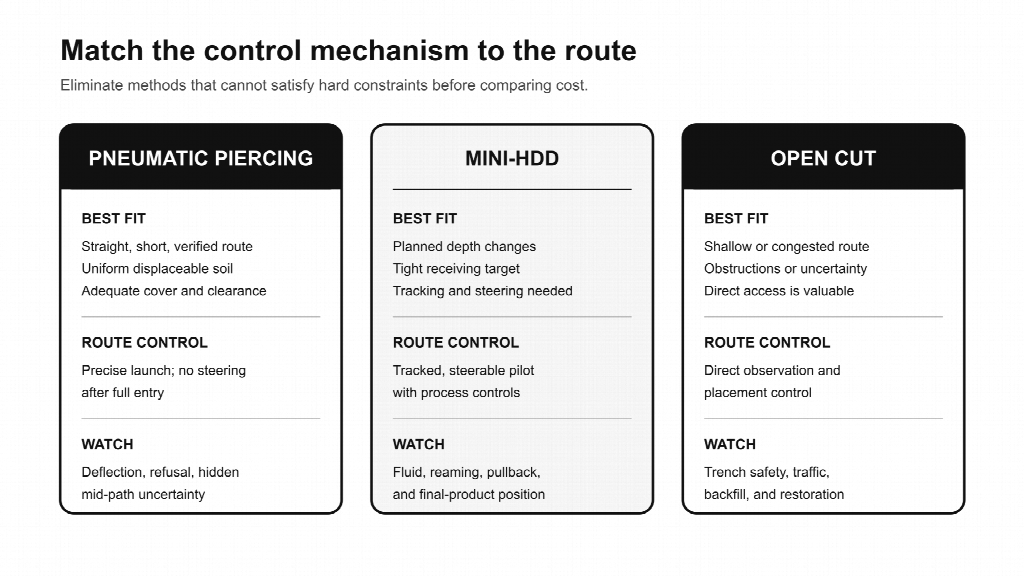
The most reliable method is the one whose control mechanism matches the route's dominant uncertainty. A concise comparison of pneumatic piercing, mini-HDD, and open cut helps frame the choice by ground, alignment, access, and consequence—not by bore length alone.
Pneumatic piercing: simple equipment, limited path control
Piercing is strongest when the route is straight, short, adequately covered, clear of close conflicts, and formed in verified uniform displaceable soil. It can minimize surface disturbance and use relatively compact support equipment. Its central limitation is equally clear: after full entry, the tool cannot be intentionally steered around an obstruction or corrected back to line.
Mini-HDD: active steering and tracking with a larger process
Mini-HDD is generally more defensible when the profile requires planned depth changes, the receiving target is tight, or tracking and steering are necessary. Those capabilities introduce their own controls: rig setup, drill-head geometry, bend radius, drilling fluid, locating accuracy, reaming, pullback load, and inadvertent-return risk. The final product in an enlarged bore may not occupy the exact pilot centerline, so steering does not eliminate the need for clearance design and verification.
Open cut: direct observation with greater surface impact
Open cut can provide the strongest direct control for shallow, congested, obstructed, or uncertain routes because the alignment and conflicts can be exposed. It also creates trench-safety, traffic, spoil, dewatering, backfill, compaction, pavement, landscaping, and restoration obligations. Where a utility conflict has severe consequences, those visible and manageable burdens may be preferable to an unobservable bore.
The decision should first eliminate methods that cannot meet hard constraints. Only then should the team compare production rate and installed cost. A cheap launch that ends in recovery excavation is not a cheap installation.
A Field Acceptance Plan for Pneumatic Piercing
A project can convert the evidence into a short release process. The objective is to decide whether piercing remains acceptable as uncertainty is removed—not to justify a method selected in advance.
Before mobilization
- Define allowable horizontal and vertical error at the exit and along the route.
- Define required separation from each known utility and structure.
- Review records, surface evidence, site history, and available ground information.
- Identify variable fill, groundwater, cobbles, roots, foundations, debris, and previous trenches.
- Select a fallback method and a safe recovery location.
- Confirm the exact tool manual, product compatibility, pulling configuration, cover, air requirement, hose, fittings, lubrication, and handling plan.
Before launch
- Complete required notifications and expose critical facilities safely.
- Measure and record launch and receiving pit geometry.
- Establish independent bearing and grade references outside disturbed ground.
- Inspect the tool and air path; verify dynamic performance under load.
- Confirm that the tool envelope plus the uncertainty corridor remains outside every required clearance.
- Brief the crew on reduced-power entry, check points, stop limits, communication, reversal, and recovery.
During the run
- Check line and grade repeatedly while correction by relaunch is still possible.
- Observe cycle consistency, advance rate, hose behavior, lubrication, ground movement, and utility exposures.
- Stop for unexpected resistance, abrupt speed change, loss of air, surface heave, pit movement, utility movement, or loss of confidence in the tool path.
- Do not treat extra air pressure as a correction for an obstruction or alignment problem.
At completion
- Measure the exit offset from the planned line and grade; do not record only “hit pit.”
- Inspect and test the installed product as required.
- Record ground observations, interruptions, recovery actions, and tool condition.
- Preserve as-built information and compare the result with the original acceptance corridor.
- Feed measured outcomes back into future method selection only when the ground, tool, setup, and tolerances are comparable.
Pneumatic piercing is reliable when its limited control is sufficient for a verified route. The evidence supports disciplined use in uniform, displaceable ground with precise launch control and realistic tolerances. It does not support a universal accuracy percentage or blind confidence based on a successful exit. Define the corridor first, quantify the launch sensitivity, verify the ground and utilities, and choose another method when the consequence of an unseen deviation exceeds what the route can tolerate.
Cabinets typically eat up the largest single slice of a kitchen remodel budget, often landing around 30 percent of the total. Countertops, appliances, labor, flooring, and permits split the rest, though the exact breakdown shifts depending on whether a project stays cosmetic or involves moving walls and plumbing. Bellevue Kitchen Remodeling from New Day Construction includes a category-by-category cost breakdown with every estimate, so homeowners see where the money actually goes rather than just a single bottom-line number.
One product that frequently appears in conversations about celebrity-branded vaping is Tyson 2.0 Legend 30K.
What stands out to me is how recognizable branding creates immediate awareness. Many consumers encounter the product because they already recognize the Tyson name.
However, after that initial introduction, most users begin asking practical questions. They want to know whether the device is reliable, convenient, and enjoyable to use.
That shift is important.
Brand recognition may encourage someone to explore a product, but actual product quality determines whether they recommend it to others or purchase it again.
In my experience, sustainable success usually depends on performance rather than publicity alone.
Hidden Hills X Fifty Bar and Collaborative Branding Trends
Another example I have noticed is Hidden Hills X Fifty Bar.
Collaborative branding has become increasingly common across many industries. Companies often combine established names to create products that appeal to multiple audiences at once.
Nexa Vape and the Importance of Product Fundamentals
While celebrity-branded products receive significant attention, I also look at brands such as Nexa Vape when comparing options.
This comparison reminds me that successful products do not always rely on celebrity associations to attract consumers.
In many cases, users prioritize reliability, convenience, and performance above all else.
The growth of portable technology has shaped these expectations. People increasingly seek products that fit easily into active lifestyles.
Whether I am evaluating Nexa Vape or a celebrity-backed alternative, I ultimately focus on how well the product integrates into daily life.
Sustainable building is often discussed in terms of materials, energy modeling, insulation strategies, or electrification. But behind every high-performance home or retrofit is something less visible and just as important: the regulatory framework that determines who is qualified to build it and how accountability is enforced.In California, contractor licensing and bonding requirements form a critical—but often overlooked—layer of this system. While these rules are commonly treated as administrative hurdles, they actually play an important role in shaping construction quality, consumer protection, and even the success of green building practices.
Understanding how contractor licensing and bonds work helps homeowners, designers, and builders better evaluate risk, improve project outcomes, and support more durable, efficient buildings.
The foundation: licensing as a quality filter
California requires most construction professionals to hold a license issued by the California Contractors State License Board (CSLB). This applies broadly to residential and commercial work above a relatively low threshold, and it covers general contractors, specialty trades, and subcontractors.
At its core, licensing serves three purposes:
Minimum competency assurance
Legal accountability for construction work
Consumer protection through enforcement mechanisms
To obtain a license, contractors must demonstrate experience, pass exams, and meet administrative requirements. While this does not guarantee craftsmanship quality, it creates a baseline expectation of professional knowledge and legal responsibility.
From a sustainable building perspective, this baseline matters more than it might initially appear. High-performance construction is less forgiving than conventional building. Air sealing, moisture management, and mechanical system integration require coordination across trades. Licensing helps ensure that individuals performing this work are at least minimally trained and accountable under state law.
Where bonds come in: financial accountability, not insurance
One of the most misunderstood components of California’s contractor system is the contractor license bond.
In California, the California contractor license bond is required for all licensed contractors as a condition of maintaining an active license, and it must be renewed regularly with the California Contractors State License Board. This bond is a form of surety protection tied to legal compliance rather than construction performance.
A common misconception is that this bond functions like insurance for the homeowner. It does not.
Instead, it is a surety bond, which involves three parties:
The contractor (the principal)
The surety company (the financial guarantor)
The public or state (the beneficiary)
The bond exists to provide financial recourse if a contractor violates licensing law, engages in misconduct, or fails to meet legal obligations.
If a valid claim is made, the surety company may compensate the harmed party—but the contractor is ultimately responsible for repaying the surety.
In other words, the bond is not designed to absorb construction risk. It is designed to enforce accountability.
Why bonding matters for building performance
At first glance, a $25,000 bond may seem irrelevant in the context of a $500,000 home renovation or new build. But its importance lies in behavior shaping rather than financial coverage.
Contractor licensing bonds influence construction quality indirectly in several ways:
1. Encouraging lawful business practices
Contractors who repeatedly violate laws risk claims against their bond, higher insurance costs, or disciplinary action. This incentivizes compliance with building codes, contracts, and wage laws.
For green building, compliance matters because sustainability features often require stricter execution tolerances. Air barriers, insulation continuity, and ventilation systems fail not because of bad design—but because of poor workmanship or skipped steps.
2. Providing a minimum consumer protection mechanism
While bonds are limited in scope, they provide homeowners with a pathway for recourse when a contractor engages in unlawful behavior.
This is particularly important in energy-efficient construction, where defects may not be immediately visible but can significantly impact performance over time.
3. Supporting market trust
A licensed and bonded contractor signals participation in a regulated system. While not a guarantee of quality, it reduces the likelihood of completely unqualified or fraudulent operators.
In a field where performance outcomes depend heavily on execution, this baseline trust is critical.
The limits of licensing and bonding in green construction
Despite their importance, licensing and bonds do not directly ensure high-performance building outcomes.
There are several key limitations:
1. Licensing does not equal specialization
A general contractor license does not require expertise in energy modeling, Passive House principles, or advanced building science. A contractor may be fully licensed yet unfamiliar with critical sustainability practices.
2. Bonds are relatively small
At $25,000, the standard contractor license bond is not sufficient to cover major construction defects or large-scale project failures. It is a compliance tool, not a safety net for construction risk.
3. Enforcement is complaint-driven
Regulatory enforcement typically occurs after a complaint is filed. This means poor-quality work can sometimes persist before action is taken.
4. Performance depends on execution quality
Even well-designed sustainable buildings can fail if air sealing, flashing, or mechanical installation is poorly executed. Licensing and bonding do not directly control jobsite quality.
Where licensing and bonds intersect with sustainable building goals
Even with their limitations, contractor licensing and bonding systems still play an important supporting role in green building ecosystems.
1. Supporting code evolution
California’s building codes are among the most progressive in the United States, particularly regarding energy efficiency and electrification. Licensed contractors are required to operate within these evolving standards, which helps normalize adoption of better building practices over time.
2. Encouraging professionalization of green trades
As sustainable building becomes more mainstream, contractors who invest in training and specialization gain a competitive advantage. Licensing provides a structured baseline from which specialization can emerge.
3. Reducing risk in experimental construction
High-performance construction often involves newer materials and assemblies. While innovation is necessary, it also introduces risk. Licensed contractors operating under bonding requirements provide a level of accountability that helps manage that risk.
What homeowners and builders should actually look for
For anyone pursuing a sustainable or high-performance project, licensing and bonding should be viewed as minimum requirements, not differentiators.
More meaningful indicators include:
Experience with energy-efficient or net-zero projects
Familiarity with blower door testing and air sealing strategies
Understanding of moisture control in complex wall assemblies
Coordination experience with HVAC designers and energy consultants
Willingness to engage in third-party verification (HERS raters, energy consultants)
A licensed and bonded contractor who lacks this expertise may still produce a code-compliant building—but not necessarily a high-performance one.
The bigger picture: regulation as infrastructure for sustainability
Sustainable building is often framed as a technical challenge, but it is also an institutional one. Energy codes, contractor licensing, and bonding requirements collectively form the infrastructure that determines how buildings are actually constructed in the real world.
In California, this system is particularly influential due to the scale of construction and the aggressiveness of its energy policies. Licensing ensures baseline competence, bonding enforces accountability, and code enforcement pushes performance standards forward.
None of these elements guarantee excellence on their own. But together, they create a framework within which better building practices can spread.
Contractor licensing and bonds may seem like administrative details compared to insulation R-values or heat pump efficiency ratings. But in practice, they shape who is allowed to build, how accountability is enforced, and how risk is managed in the construction process.
For sustainable building to succeed at scale, it must exist not just as a set of design ideals, but as a regulated, enforceable system. In California, contractor licensing and bonding are part of that system—quietly influencing the quality, durability, and performance of the built environment.
Understanding them doesn’t replace technical building knowledge. But it does complete the picture of how better buildings actually get built.